Definitions
Thread: Lightweight process executing code independently. Multiple threads share same process memory. Enables concurrent execution.
Multithreading: Multiple threads executing simultaneously (or appearing simultaneous in single-core). Increases responsiveness and throughput.
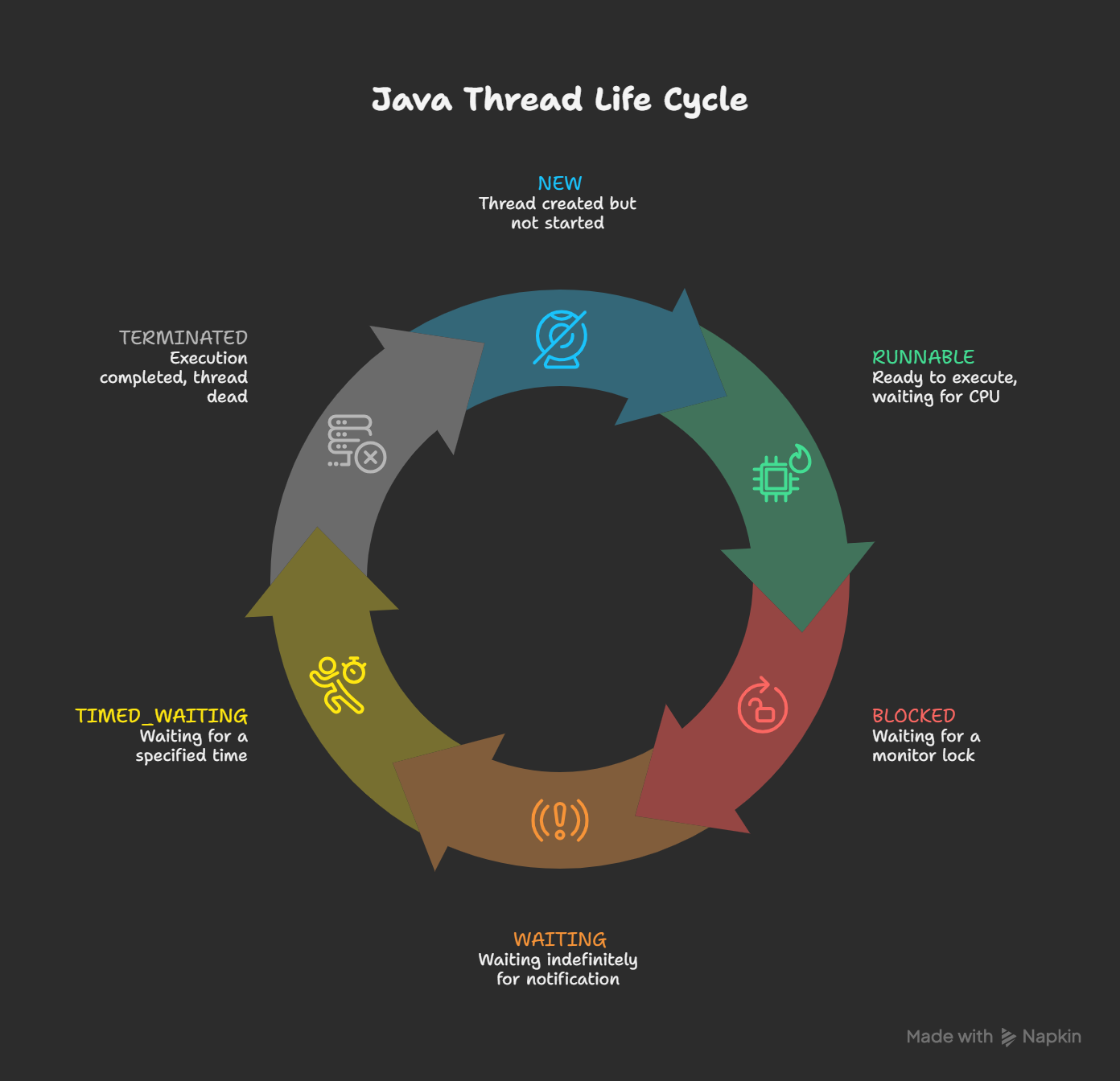
Thread Lifecycle: NEW → RUNNABLE → BLOCKED/WAITING/TIMED_WAITING → TERMINATED.
synchronized Keyword: Method or block restricting access to single thread. Enforces mutual exclusion and happens-before relationship.
volatile Keyword: Variables ensuring visibility of writes across threads. Prevents caching; reads/writes always from main memory.
Race Condition: Multiple threads accessing shared data simultaneously without synchronization, causing unpredictable results.
QnA
How do you create a thread in Java?
Extend Thread class or implement Runnable interface (preferred for multiple inheritance). Call start() method (not run()) to create new thread and invoke run() asynchronously. For example, new Thread(new MyTask()).start(); creates and starts a new thread. Never call run() directly—it executes in current thread.
What’s the difference between Thread.start() and Thread.run()?
start() creates a new thread and calls run() asynchronously in that thread. run() executes in the current thread, blocking until complete. Always use start() for concurrent execution; run() directly defeats threading purposes. This is a common mistake causing single-threaded behavior.
What does the volatile keyword do?
Volatile ensures a variable’s visibility across threads—writes become immediately visible to other threads. It prevents JVM from caching the variable value; reads and writes always access main memory. Use volatile for flags or simple values. Note: volatile doesn’t guarantee atomicity, only visibility.
What’s the difference between synchronized and volatile?
Synchronized provides both mutual exclusion (only one thread at a time) and visibility. Volatile provides only visibility, not atomicity. Use synchronized for shared data being modified; use volatile for flags or simple communication. Synchronized is more expensive; use judiciously.
What causes deadlock?
Thread A waits for lock held by B; B waits for lock held by A. Circular wait prevents progress. Deadlocks are hard to detect and reproduce. Prevention strategies: consistent lock ordering (always acquire locks in same order), avoid nested locks, use timeouts (tryLock), or use lock-free algorithms.
How do you prevent deadlock?
Strategies include: maintaining consistent lock ordering across threads, avoiding nested/multiple lock acquisitions, using timeouts with tryLock(), using concurrent data structures (ConcurrentHashMap), or lock-free algorithms. Design is critical—prevent deadlock scenarios rather than trying to recover from them.
Code Examples
Example - Creating & Starting Threads:
// Approach 1: Extend Thread
class MyThread extends Thread {
    public void run() {
        System.out.println("Thread: " + Thread.currentThread().getName());
    }
}
MyThread thread = new MyThread();
thread.start();  // Correct

// Approach 2: Implement Runnable (preferred)
class MyTask implements Runnable {
    public void run() {
        System.out.println("Task running");
    }
}
new Thread(new MyTask()).start();

// Approach 3: Lambda (Java 8+)
new Thread(() -> {
    System.out.println("Lambda thread");
}).start();
Example - synchronized Method:
public class Counter {
    private int count = 0;

    // synchronized ensures only one thread at a time
    public synchronized void increment() {
        count++;  // Safe from race conditions
    }

    public synchronized int getCount() {
        return count;
    }
}

// Concurrent calls
Counter counter = new Counter();
for (int i = 0; i < 100; i++) {
    new Thread(() -> {
        for (int j = 0; j < 1000; j++) {
            counter.increment();
        }
    }).start();
}
// Guaranteed: count = 100,000 (thread-safe)
Example - synchronized Block:
public class Account {
    private int balance = 1000;

    public void transfer(Account to, int amount) {
        synchronized (this) {
            if (balance >= amount) {
                balance -= amount;
            }
        }
        synchronized (to) {
            to.balance += amount;
        }
    }
}
Example - volatile Keyword:
public class TaskRunner {
    private volatile boolean running = true;  // Visibility

    public void stop() {
        running = false;  // All threads see immediately
    }

    public void run() {
        while (running) {
            // Work continues
        }
    }
}
Key Points
- Thread States: NEW, RUNNABLE, BLOCKED, WAITING, TIMED_WAITING, TERMINATED. State transitions crucial for understanding concurrency.
- happens-before: Synchronized ensures all changes visible before lock release; thread-safe memory visibility.
- Intrinsic Locks: Every object has built-in lock (monitor). Synchronized acquires object’s lock automatically.
- Thread Scheduling: JVM/OS decides execution order; non-deterministic. Assume worst-case interleaving always.
- Synchronization Overhead: Locking has performance cost; use only when necessary. Consider lock-free alternatives for high contention.