Definitions
Queue: FIFO (First-In-First-Out) collection. Elements added at tail, removed from head. Implementations: LinkedList, PriorityQueue.
Deque: Double-ended queue allowing insertion/removal at both ends. Can be used as Queue or Stack.
Stack: LIFO (Last-In-First-Out) collection. Element added/removed from top. Legacy (Vector-based); use Deque for new code.
PriorityQueue: Elements ordered by priority (Comparator). Head is lowest-priority element.
Optional: Container for possibly null values. Avoids null checks; encourages functional approach.
QnA
What’s the difference between Queue and Deque?
Queue is a FIFO collection where elements are added at the tail and removed from the head. Deque (double-ended queue) allows adding and removing from both ends, making it flexible for both FIFO (queue) and LIFO (stack) operations. Choose Queue for strict FIFO semantics; Deque when you need flexibility.
How does PriorityQueue order elements?
PriorityQueue orders elements by natural order (using Comparable) or a custom Comparator. The head element is the smallest according to the ordering. It’s implemented as a heap, providing O(log n) insertion/removal. Iterating through the queue doesn’t produce sorted order; only removal guarantees order.
Should you use the Stack class in new code?
No, the Stack class extends Vector (legacy and synchronized). Use Deque with methods push(), pop(), peek() on ArrayDeque instead. ArrayDeque is faster, not synchronized, and provides better performance. For example, Deque<Integer> stack = new ArrayDeque<>();
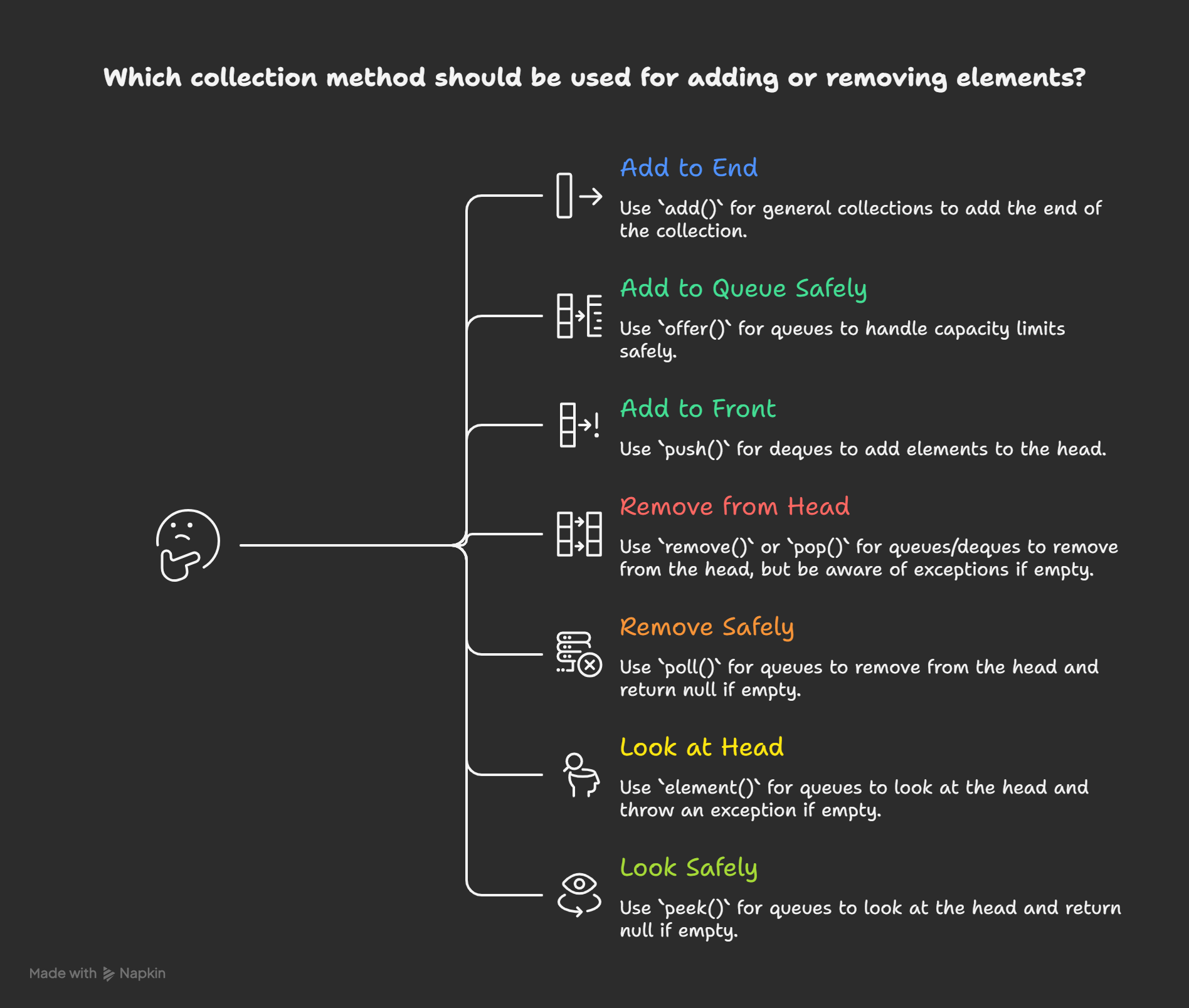
Which collection method should be used for adding or removing elements?
| Method | Interface | Action | If Full / Empty? |
|---|---|---|---|
add(e) | Collection | Adds to end (Tail) | Throws Exception (if capacity restricted) |
offer(e) | Queue | Adds to end (Tail) | Returns false (safe for capacity limits) |
push(e) | Deque | Adds to front (Head) | Throws Exception (if capacity restricted) |
remove() | Queue | Removes from Head | Throws Exception if empty |
pop() | Deque | Removes from Head | Throws Exception if empty |
poll() | Queue | Removes from Head | Returns null if empty |
element() | Queue | Looks at Head | Throws Exception if empty |
peek() | Queue | Looks at Head | Returns null if empty |
What methods does Queue provide?
Queue provides three types of methods: add/offer (insert), remove/poll (remove), element/peek (inspect). Exception-throwing methods (add, remove, element) throw NoSuchElementException if queue is empty; null-returning methods (offer, poll, peek) return null. Use null-returning versions for safe handling.
How can add method in Queue result in an Exception?
The add(E e) method will throw an IllegalStateException if the element cannot be added at that moment due to capacity restrictions. This most commonly happens with Bounded Queues (queues with a fixed size limit), such as an ArrayBlockingQueue or a LinkedBlockingQueue that was initialized with a specific capacity.
Why use Optional instead of null?
Optional makes null handling explicit and allows functional chaining. Instead of checking if (value != null), you chain operations like value.map(...).orElse(default). This eliminates NullPointerException risks and encourages cleaner code. Optional is a container signaling a value might be absent.
Can Optional be used in fields?
Discouraged. Optional adds overhead and is designed for return types and method parameters. For fields, either allow null with clear documentation or use validation in constructors. Using Optional fields complicates code without significant benefit.
Code Examples
Example - Queue Operations:
Queue<String> queue = new LinkedList<>();
queue.add("Task1");
queue.add("Task2");
queue.add("Task3");

// Peek at head
System.out.println(queue.peek());  // Task1

// Remove from head
String task = queue.poll();        // Task1

// Iteration
while (!queue.isEmpty()) {
    System.out.println(queue.poll());
}

// Exception-throwing
Queue<Integer> q = new LinkedList<>();
// q.remove();  // NoSuchElementException
q.poll();      // Returns null (safe)
Example - PriorityQueue (Min-Heap):
PriorityQueue<Integer> minHeap = new PriorityQueue<>();
minHeap.add(30);
minHeap.add(10);
minHeap.add(20);

System.out.println(minHeap.poll());  // 10
System.out.println(minHeap.poll());  // 20
System.out.println(minHeap.poll());  // 30

// Max-heap with reverse comparator
PriorityQueue<Integer> maxHeap = new PriorityQueue<>((a, b) -> b - a);
maxHeap.add(30);
maxHeap.add(10);
maxHeap.add(20);

System.out.println(maxHeap.poll());  // 30
Example - Deque (Stack & Queue):
Deque<Integer> deque = new ArrayDeque<>();

// Queue operations
deque.addLast(1);
deque.addLast(2);
System.out.println(deque.pollFirst());  // 1

// Stack operations
deque.push(10);
deque.push(20);
System.out.println(deque.pop());  // 20

// Both ends access
System.out.println(deque.peekFirst());  // 10
System.out.println(deque.peekLast());   // 2
Example - Optional Usage:
Optional<String> name = Optional.of("Alice");

// Check and process
if (name.isPresent()) {
    System.out.println(name.get());
}

// Use ifPresent (cleaner)
name.ifPresent(n -> System.out.println(n));

// Get with default
String value = name.orElse("Unknown");
value = name.orElseGet(() -> "Default");

// Transformations
Optional<Integer> length = name.map(String::length);
Optional<String> upper = name.filter(n -> n.startsWith("A")).map(String::toUpperCase);

// Empty optional
Optional<String> empty = Optional.empty();
System.out.println(empty.orElse("Default"));  // Default
Key Points
- Queue vs Deque: Choose Queue for FIFO; Deque for flexibility (Stack/Queue behavior).
- PriorityQueue Not Sorted: Iterating doesn’t give sorted order; only removal guarantees order.
- ArrayDeque vs LinkedList: ArrayDeque faster for Deque operations; LinkedList better for List needs.
- Optional Chaining: Use map(), flatMap(), filter() for functional transformations vs. multiple if-checks.
- Exception vs Null: Exception-throwing methods (add, remove, element) vs. null-returning (offer, poll, peek).