Definitions
Collection: Root interface for group of objects. Types: List (ordered), Set (unique), Queue (FIFO).
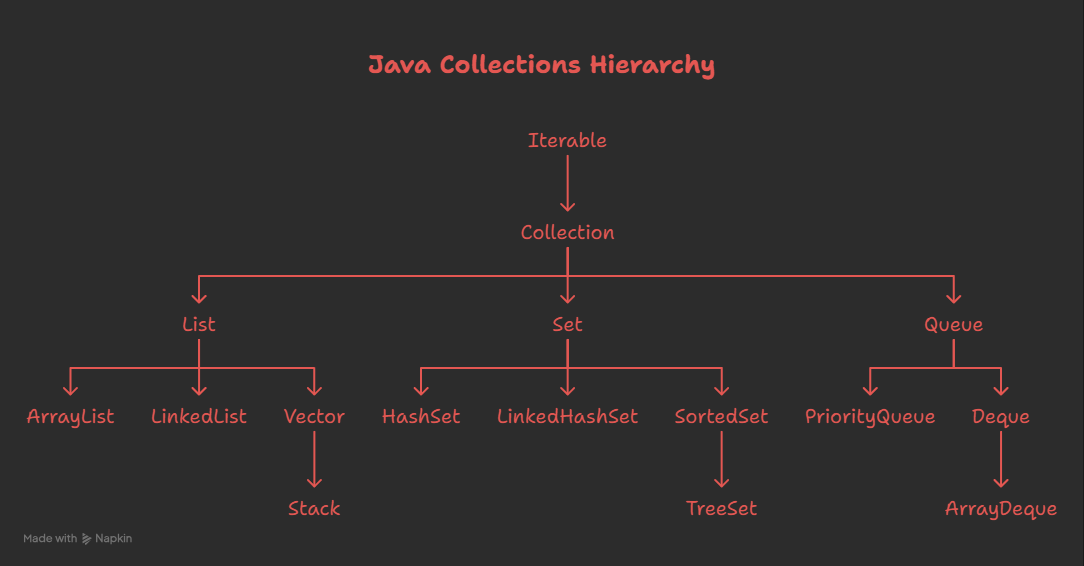
List: Ordered collection allowing duplicates and null. Index-based access. Implementations: ArrayList (dynamic array), LinkedList (doubly-linked).
Set: Unordered collection disallowing duplicates. No index access. Implementations: HashSet (hash-based), TreeSet (sorted, Red-Black tree).
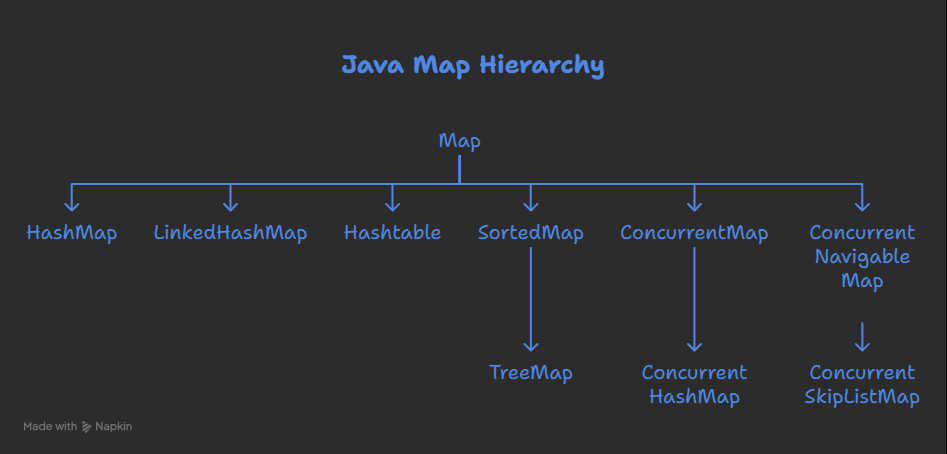
Map: Key-value pairs with unique keys. Implementations: HashMap (fast, unordered), TreeMap (sorted keys), LinkedHashMap (insertion order).
Iterator: Object for traversing collections. Provides hasNext(), next(), remove() methods.
QnA
What’s the difference between List and Set?
Lists are ordered collections that allow duplicates and provide index-based access (e.g., get(0) returns first element). Sets are unordered collections that disallow duplicates and don’t provide index-based access. If you need to maintain order and allow duplicates, use List; if you need uniqueness with fast lookup, use Set.
When should you use ArrayList vs LinkedList?
ArrayList provides fast random access with O(1) complexity but slow insertion/deletion at the middle (O(n)) because elements need shifting. LinkedList has slow access (O(n)) but fast insertion/deletion at any position (O(1)) since it only requires pointer updates. Use ArrayList for frequent access; use LinkedList for frequent insertions/deletions.
Why doesn’t Map extend Collection?
Maps have key-value pair structure fundamentally different from Collections which hold single values. The contract and iteration pattern differ: Collection iterates values, while Map iterates entries (key-value pairs). This structural difference warranted a separate interface hierarchy.
What’s the difference between HashMap and TreeMap?
| Feature | HashMap | TreeMap |
|---|---|---|
| Performance | O(1) average case | O(log n) |
| Ordering | Unordered (no predictable order) | Sorted by key (uses Comparator) |
| Null Keys | Allows one null key | No null keys allowed |
| Memory | Lower memory overhead | Slightly higher due to tree structure |
| Use Case | Fast lookup when order doesn’t matter | Need sorted keys or range queries |
Can HashMap have null keys and values?
Yes, HashMap allows one null key and multiple null values. This is a key difference from TreeMap, which doesn’t allow null keys because the compareTo() method would throw NullPointerException. However, null values are allowed in TreeMap.
What’s the default capacity of ArrayList?
ArrayList starts with a default capacity of 10 elements. When the list becomes full, it grows by 50% (new size = oldSize * 3/2). This dynamic growth strategy balances memory efficiency with performance, avoiding excessive copying operations.
How does Java know if List.remove(int i) refers to index or value?
The List interface provides two primary remove methods:
remove(int index): Removes the element at the specified position.remove(Object o): Removes the first occurrence of the specific object.
When your list contains Integers, a call like list.remove(1) is ambiguous to the human eye, but Java will always prioritize the primitive int (the index).
| Code | Result | Why? |
|---|---|---|
list.remove(1) | Removes Index 1 | Java treats the literal 1 as a primitive int by default. |
list.remove(Integer.valueOf(1)) | Removes Value 1 | You are explicitly passing an Object, so it matches the value-based method. |
Code Examples
Example - List Operations:
List<String> fruits = new ArrayList<>();
fruits.add("Apple");
fruits.add("Banana");
fruits.add("Orange");

// Access by index
System.out.println(fruits.get(0));  // Apple

// Iteration
for (String fruit : fruits) {
    System.out.println(fruit);
}

// Using Iterator
Iterator<String> it = fruits.iterator();
while (it.hasNext()) {
    System.out.println(it.next());
}

// Remove
fruits.remove(1);  // Remove by index
fruits.remove("Banana");  // Remove by value
Example - Set Operations:
Set<Integer> numbers = new HashSet<>();
numbers.add(10);
numbers.add(20);
numbers.add(10);  // Duplicate, ignored
System.out.println(numbers.size());  // 2

// Order not guaranteed
for (Integer num : numbers) {
    System.out.println(num);
}

// TreeSet maintains sorted order
Set<Integer> sorted = new TreeSet<>(numbers);
for (Integer num : sorted) {
    System.out.println(num);  // 10, 20 (sorted)
}
Example - Map Operations:
Map<String, Integer> scores = new HashMap<>();
scores.put("Alice", 95);
scores.put("Bob", 87);
scores.put("Charlie", 92);

// Get value
System.out.println(scores.get("Alice"));  // 95

// Check containment
if (scores.containsKey("Alice")) {
    System.out.println("Alice found");
}

// Iterate entries
for (Map.Entry<String, Integer> entry : scores.entrySet()) {
    System.out.println(entry.getKey() + ": " + entry.getValue());
}

// Get keys or values
for (String name : scores.keySet()) {
    System.out.println(name);
}

for (Integer score : scores.values()) {
    System.out.println(score);
}

// Remove
scores.remove("Bob");
Example - Collections Utility Methods:
List<Integer> list = new ArrayList<>(Arrays.asList(3, 1, 4, 1, 5));

Collections.sort(list);              // Ascending order
Collections.reverse(list);           // Reverse
Collections.shuffle(list);           // Random order
int maxVal = Collections.max(list);  // Maximum element
Collections.fill(list, 0);           // Fill with value
Collections.replaceAll(list, 1, 99); // Replace all occurrences

// Unmodifiable collections
List<Integer> immutable = Collections.unmodifiableList(list);
Key Points
- Fail-Fast Iterator: If collection modified during iteration, ConcurrentModificationException thrown. Use Iterator.remove() for safe removal.
- HashMap Collision: Uses chaining (linked list) for hash collisions. Java 8+ uses balanced trees when chain length exceeds 8.
- Collection Ordering: List maintains insertion order; HashSet doesn’t; TreeSet sorted; LinkedHashSet preserves insertion order.
- Performance Trade-off: HashMap faster but unordered; TreeMap slower but sorted—choose based on need.
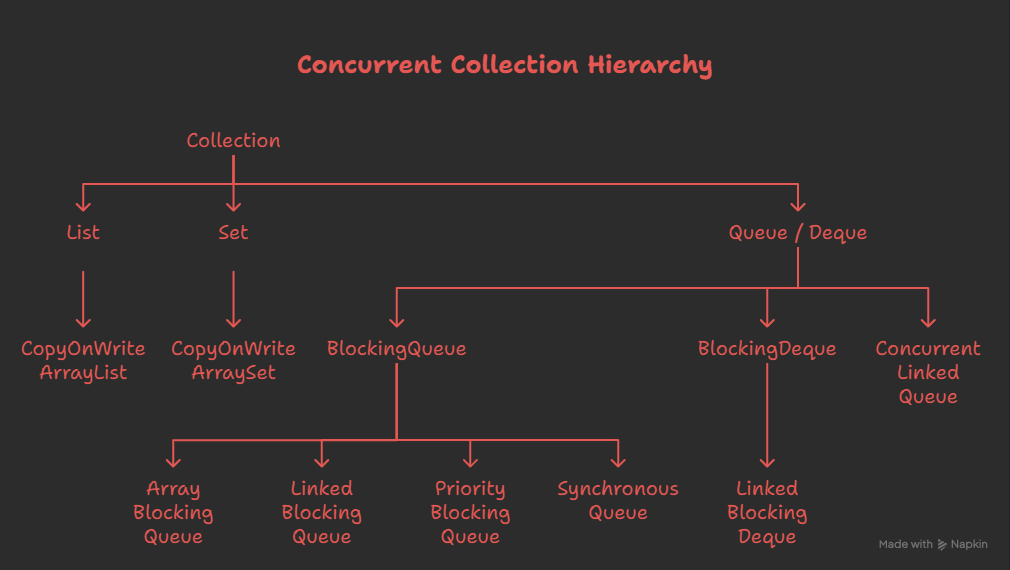
- Thread Safety: Collections not thread-safe by default. Use
Collections.synchronizedList(),ConcurrentHashMap, or external synchronization.